Why Smart Travelers Are Choosing Serviced Apartments Over Hotels in 2026
Something has shifted in the way people travel. It is not a sudden dramatic change but rather a quiet, steady evolution in priorities, one that has been building for several years and has now reached a point where it is genuinely reshaping the accommodation industry. Travellers in 2026 are more informed, more discerning, and more deliberate about where they spend their money than at any point in recent history. And a growing number of them are reaching the same conclusion: serviced apartments simply make more sense than hotels for the vast majority of trips.
This is not a niche trend confined to a particular type of traveller. It is happening across the full spectrum of travel purposes and demographics. Business professionals on extended assignments are choosing serviced apartments. Families on city breaks are choosing serviced apartments. Relocating individuals and couples are choosing serviced apartments. Groups of friends celebrating milestones are choosing serviced apartments. Even the occasional solo weekend traveller, once the most hotel-dependent of all visitor types, is increasingly looking at what a quality serviced apartment can offer and finding that the answer is rather a lot.
What is driving this shift? Why are smart travellers in 2026 choosing serviced apartments over hotels with such consistency and conviction? And if you have not yet made this switch yourself, what might you be missing?
This guide addresses all of those questions honestly and comprehensively. By the time you finish reading, you will understand exactly why the world's most experienced and savvy travellers are rethinking the hotel default, and what that means for how you plan your next stay in Manchester or anywhere else.
1. The Changing Face of Travel in 2026
Travel in 2026 looks meaningfully different from travel even five years ago, and the differences are not superficial. The boundaries between work and leisure travel have blurred substantially. The rise of remote and hybrid working has given millions of professionals the freedom to work from virtually anywhere, turning what was once a purely functional business trip into something more nuanced and more personally important. The concept of the "bleisure" trip, combining business and leisure in a single visit, has moved from buzzword to standard practice for a significant proportion of frequent travellers.
At the same time, cost consciousness has sharpened. Across multiple years of economic uncertainty and inflation, travellers have become more rigorous about extracting genuine value from every aspect of a trip. Paying a premium for accommodation that does not deliver a meaningfully better experience is less acceptable than it once was, and travellers are willing to do the research to find alternatives that offer more for their money.
The growth of digital platforms has made that research easier than ever. Travellers in 2026 can compare accommodation options with a depth and ease that was simply not possible a decade ago. They can read detailed, verified reviews from thousands of previous guests. They can compare the true all-in cost of different accommodation types side by side. They can access professional-grade photography and virtual tours of properties before they book. And they can reach out directly to management teams to ask specific questions and assess the quality of response before committing.
All of these factors combine to create a traveller who is better informed, more value-conscious, and more willing to challenge long-standing accommodation defaults than at any previous point. And when that traveller applies their intelligence to the question of where to stay, they increasingly arrive at the same answer: a well-managed serviced apartment outperforms a hotel across most of the dimensions that actually matter.
2. The Space Revolution: Why Square Footage Actually Matters
Ask any experienced frequent traveller what they wish they had prioritised earlier in their travel life and a significant number will give you the same answer: space. The difference between a 25 square metre hotel room and a 55 square metre serviced apartment is not just a number on a floor plan. It is a fundamentally different quality of daily life during your stay.
In a hotel room, you exist in a single environment. The bed dominates. There is typically a small desk, a television mounted on the wall, a narrow strip of floor between the bed and the bathroom door, and if you are lucky, a chair that is just uncomfortable enough to discourage spending too much time in it. Everything you do during your non-sleeping hours happens in this same space. You eat there, work there, relax there, and prepare yourself there. After one night, this is fine. After three nights, the walls begin to feel closer. After a week, it is genuinely difficult to maintain any sense of wellbeing or perspective.
A serviced apartment solves this entirely. You have a kitchen where cooking happens. A living room where relaxing happens. A dining area where eating happens. A bedroom that is exclusively for sleeping and genuinely functions as a restorative space because it is not also the room where you have been sitting for the past eight hours. A bathroom that is not shared with the space you inhabit for every other purpose.
Smart travellers in 2026 have worked out that the psychological impact of having distinct, purposeful spaces within their accommodation is not a luxury consideration. It is a fundamental quality-of-life factor that shapes their mood, their energy, their productivity, and their enjoyment of the destination. Once you have stayed in a quality serviced apartment, the spatial logic of hotel rooms becomes very difficult to accept willingly.
3. The Financial Reality: Serviced Apartments and the True Cost of Travel
One of the most persistent myths about serviced apartments is that they are more expensive than hotels. For a single night, this can occasionally be true. For any stay of two nights or more, when the true total cost of each option is honestly accounted for, the myth dissolves rapidly.
Consider what a typical three-night stay in a mid-range Manchester hotel actually costs. A nightly room rate of around £130 gives you £390 for three nights. Breakfast at £15 per person per day adds £90 for two people. Three dinners out at a modest average of £45 per person adds £270 for two people. One round of room service adds £35. Hotel parking for three days adds £60. Hotel laundry for a few items adds £25. Total: approximately £870 for two people over three nights, before a single tourist attraction, drink, or retail purchase.
Now consider a well-appointed one-bedroom serviced apartment in Manchester for the same three nights. A rate of £130 per night gives you £390. You make your own breakfasts from a properly stocked kitchen: say £30 for three mornings for two people. You eat out for dinner twice and cook once at home: say £180 versus £270. You do your own laundry: £0. Parking, if included: £0. Total: approximately £600 for two people over three nights, a saving of around £270 on a three-night stay.
Scale this to a week and the saving approaches £600. Scale it to a month and the difference becomes genuinely significant. Smart travellers in 2026 are running these numbers before they book, and the results consistently point in the same direction.
The important caveat is that this comparison assumes genuinely comparable quality. A budget serviced apartment versus a luxury hotel is not a fair comparison. But like-for-like, at every quality tier, the serviced apartment delivers more per pound spent across any stay of meaningful duration.
4. The Kitchen Factor: Why Self-Catering Changes Everything
The kitchen in a serviced apartment is not just a cost-saving device. It is a quality-of-life multiplier that affects almost every aspect of the stay experience, from health and routine to budget and flexibility.
Think about what access to a proper kitchen actually enables during a city stay.
It enables breakfast on your terms. Not a hotel breakfast that finishes at 10am and costs £15 for something you could make yourself in ten minutes. Your own breakfast, at your own pace, with your own food, at whatever time suits your day.
It enables healthy eating during travel. One of the most consistent complaints among frequent travellers is how difficult it is to maintain healthy eating habits when living out of hotels. Every meal comes from a restaurant, a room service menu, or a hotel buffet, none of which are reliably aligned with your normal dietary preferences or nutritional goals. A kitchen changes this completely. You can shop locally, cook simply, and eat in a way that supports your health rather than eroding it across the duration of your stay.
It enables flexibility and spontaneity. Do you want a late supper after an evening event without paying restaurant prices at 11pm? A bowl of pasta in your own kitchen costs £2 and takes fifteen minutes. Do you want a proper lunch without leaving the apartment during a working day? Entirely possible. Do you want to try the local market and cook with what you find? The kitchen makes this experience available to you.
It enables genuine savings without genuine sacrifice. Eating out for every meal during a city stay is expensive and can become exhausting. The ability to rotate between restaurant meals and home cooking means you can invest in the restaurant experiences that genuinely matter, the brilliant Ancoats tasting menu or the celebrated Northern Quarter brunch spot, without feeling obligated to eat out every single time.
Smart travellers understand that the kitchen is not a feature they will probably not use. It is a feature that will change the shape of their entire stay.
5. The Remote Work Revolution and Its Impact on Accommodation Choices
The shift to remote and hybrid working, accelerated dramatically in recent years, has had a profound effect on accommodation preferences. When work follows you on a trip, the requirements of your accommodation expand significantly beyond a place to sleep.
A generation ago, business travel typically meant going somewhere for a fixed purpose, attending meetings or a conference, and returning. The accommodation was a base for sleeping and preparing, not a functional workspace. Today, millions of professionals travel with the expectation and requirement of working effectively from their accommodation. Video calls, document preparation, email management, project collaboration: all of this happens in the room, the apartment, or wherever they are based.
Hotels have adapted to some extent. Most now offer Wi-Fi and a small desk. But the limitations remain significant. A small desk squeezed into a corner of a 25 square metre room is not a productive workspace. Shared hotel Wi-Fi that degrades under the load of multiple simultaneous users is not a reliable connection for important calls. The absence of a proper living area means that the distinction between workspace and rest space collapses entirely, with consequences for both productivity and wellbeing.
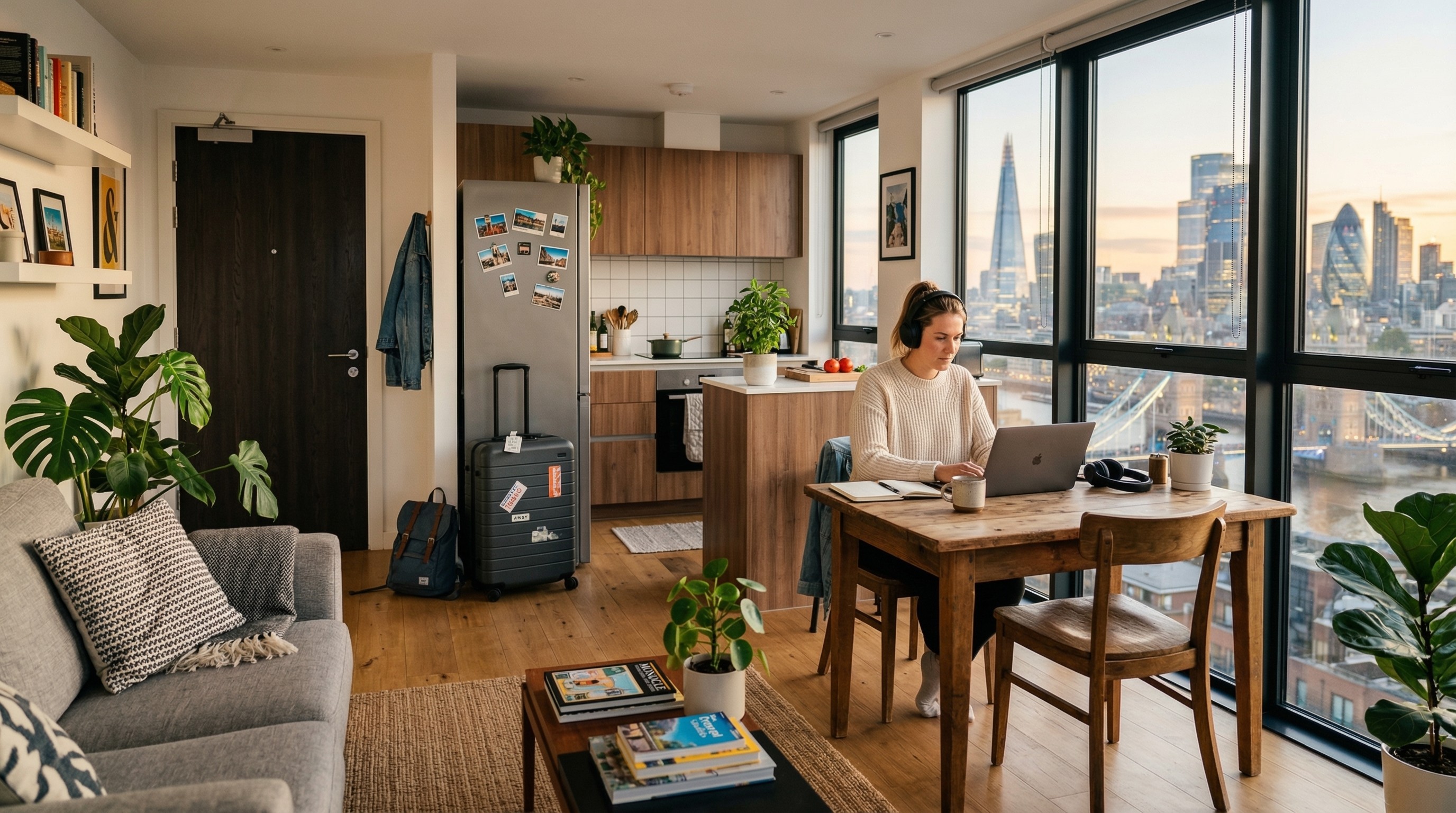
A quality serviced apartment addresses the remote work requirement comprehensively. A dedicated desk in a separate area from the bedroom, fast and exclusive broadband, a kitchen that supports meal preparation around a working schedule, and the acoustic privacy of a self-contained unit rather than a hotel room adjacent to busy corridors and neighbouring guests. These are not minor improvements. They are the difference between accommodation that actively supports effective work and accommodation that merely tolerates it.
In 2026, with remote and hybrid working firmly established as the norm for a large proportion of the professional population, the serviced apartment's superiority for the working traveller is not a selling point. It is simply a fact.
6. Privacy, Independence, and the Freedom to Just Be
There is something about hotel living that imposes a subtle but persistent sense of performance. You are always, in some small way, on display. In the lobby, in the corridor, at the breakfast buffet, calling reception. You are a guest in someone else's managed environment, and the experience of being a guest, however pleasant, is fundamentally different from the experience of being at home.
Serviced apartments offer something that hotels structurally cannot: genuine privacy and the freedom to inhabit a space without any social performance whatsoever. Your own front door. Your own key. Your own schedule. Nobody knocking to ask about housekeeping. Nobody to engage with in a shared lift or a lobby. Nobody else's breakfast preferences competing with yours. Just you and your space.
For many travellers, this privacy is not about introversion or antisociability. It is about the psychological restoration that comes from having a genuinely private domestic environment after a day of being fully socially engaged. The meeting-heavy business traveller who needs an hour of complete quiet before they can decompress properly. The family that needs to put children to bed without the complications of hotel corridor noise and paper-thin walls. The couple who want to spend an evening in without the ambient hotel environment constantly reminding them they are temporary occupants.
Smart travellers in 2026 have recognised that privacy and independence are not premium add-ons. They are core requirements for a stay that genuinely restores and supports the person staying.
7. Health and Wellbeing: How Your Accommodation Affects Your Trip
The connection between accommodation quality and traveller wellbeing is better understood in 2026 than ever before, and it is influencing booking decisions in meaningful ways.
Sleep quality is the foundation. A serviced apartment typically offers a better sleep environment than a comparable hotel room because of the absence of corridor noise, the ability to control room temperature independently, the availability of proper blackout options, and the psychological benefit of sleeping in a space that is physically separate from everything else you have been doing during the day.
Nutrition is significantly better supported in a serviced apartment. The ability to cook means the ability to eat well. Not every meal needs to be a healthy home-cooked one, but having the option available and exercising it regularly across a trip makes a measurable difference to energy levels, mood, and physical resilience.
Routine maintenance is easier in a serviced apartment. Your morning routine, your exercise habits if you run or follow a home workout, your specific dietary requirements, your evening wind-down process: all of these are easier to maintain in a space that gives you the infrastructure to support them.
Mental health benefits substantially from the sense of settlement and stability that a properly managed serviced apartment provides, particularly on longer trips. The feeling of having a genuine home base rather than a temporary lodging is not sentimental. It has real and documented psychological value, reducing the ambient stress of displacement and freeing mental and emotional resources for the actual purpose of the trip.
Research in hospitality wellbeing consistently shows that extended-stay guests in serviced apartment accommodation report higher overall satisfaction, better physical health maintenance, and lower stress levels than comparable travellers in hotel accommodation. Smart travellers in 2026 are aware of this research and acting on it.
8. Sustainability and Responsible Travel in 2026
Sustainability has moved from a nice-to-have consideration to a genuine decision factor for a growing proportion of travellers. And on the sustainability dimension, serviced apartments compare favourably to hotels in several meaningful ways.
Energy consumption: Large hotels, with their constant lighting, climate control across hundreds of rooms, pool and spa heating, extensive food service operations, and continuous laundry processing, consume significant energy per guest night. A serviced apartment, used by a single group of guests who control their own heating, lighting, and appliance use, typically has a considerably lower energy footprint per night of occupation.
Waste generation: Hotel operations generate substantial waste. Daily room refreshes that replace barely used toiletries. Breakfast buffets that prepare food for maximum numbers and discard what remains. Individual minibar items in single-use packaging. A serviced apartment guest buys their own provisions, uses them fully, and manages their own waste in a way that more closely mirrors normal domestic life.
Cleaning chemicals and water: Daily hotel housekeeping uses significant quantities of cleaning products and water. Serviced apartment housekeeping, typically on a weekly rather than daily schedule, reduces this consumption considerably.
Local economic engagement: Serviced apartment guests, because they self-cater, shop at local markets and supermarkets. They are more likely to eat at independent local restaurants because they are not tied to the hotel's own food service offering. This spending pattern tends to distribute economic benefit more widely within the local community than hotel guest spending, which concentrates within the hotel's own operations.
According to the Global Sustainable Tourism Council, accommodation sustainability is an increasingly important criterion for traveller decision-making across all demographics. Serviced apartments, by their nature, align well with these sustainability priorities in ways that large hotel operations find more difficult to match.
9. The Technology Advantage: How Serviced Apartments Are Getting Smarter
The integration of technology into the serviced apartment experience has accelerated significantly in recent years, and in 2026 the best-managed properties offer a genuinely seamless, tech-enabled stay that addresses many of the traditional friction points of non-hotel accommodation.
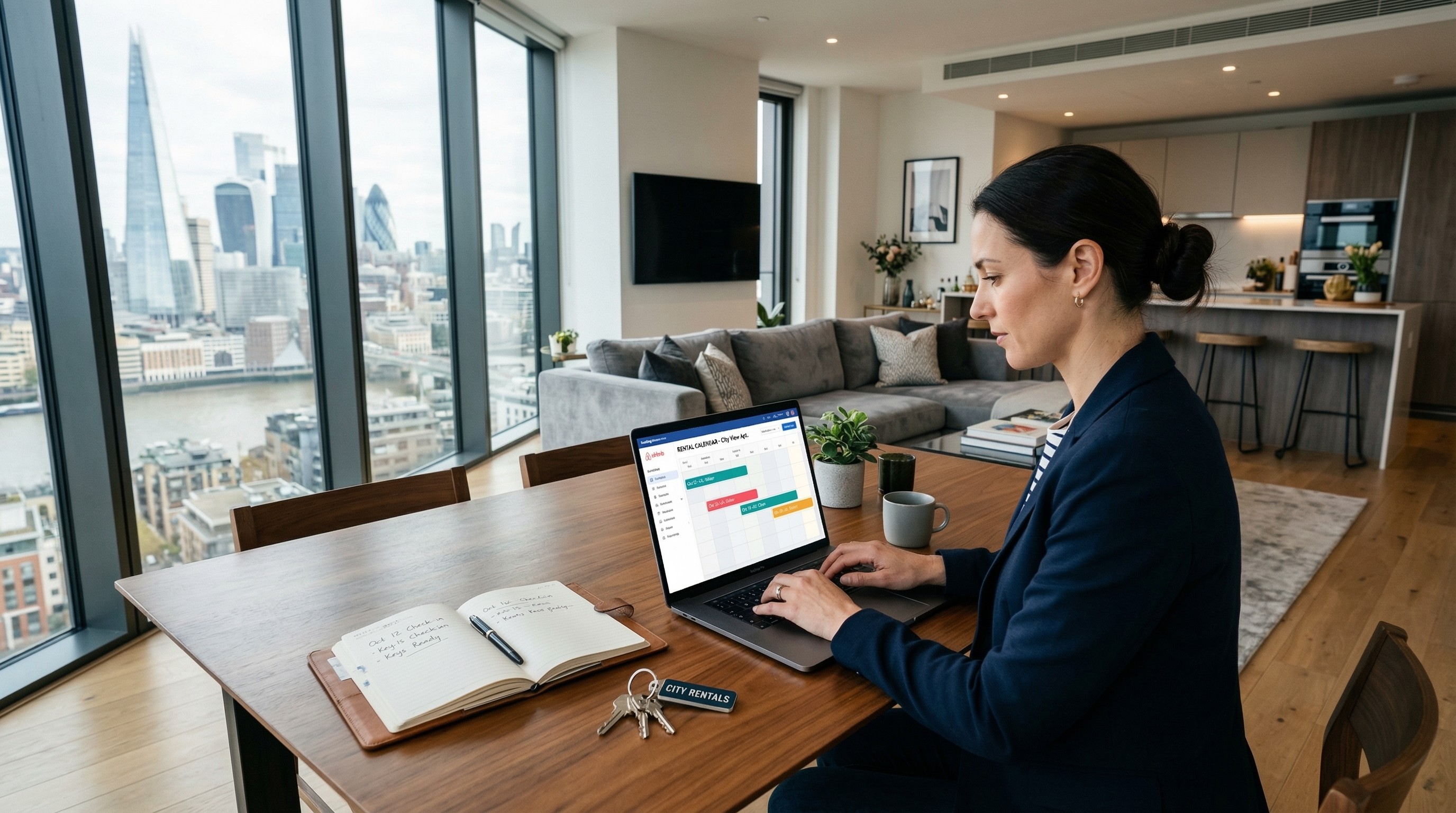
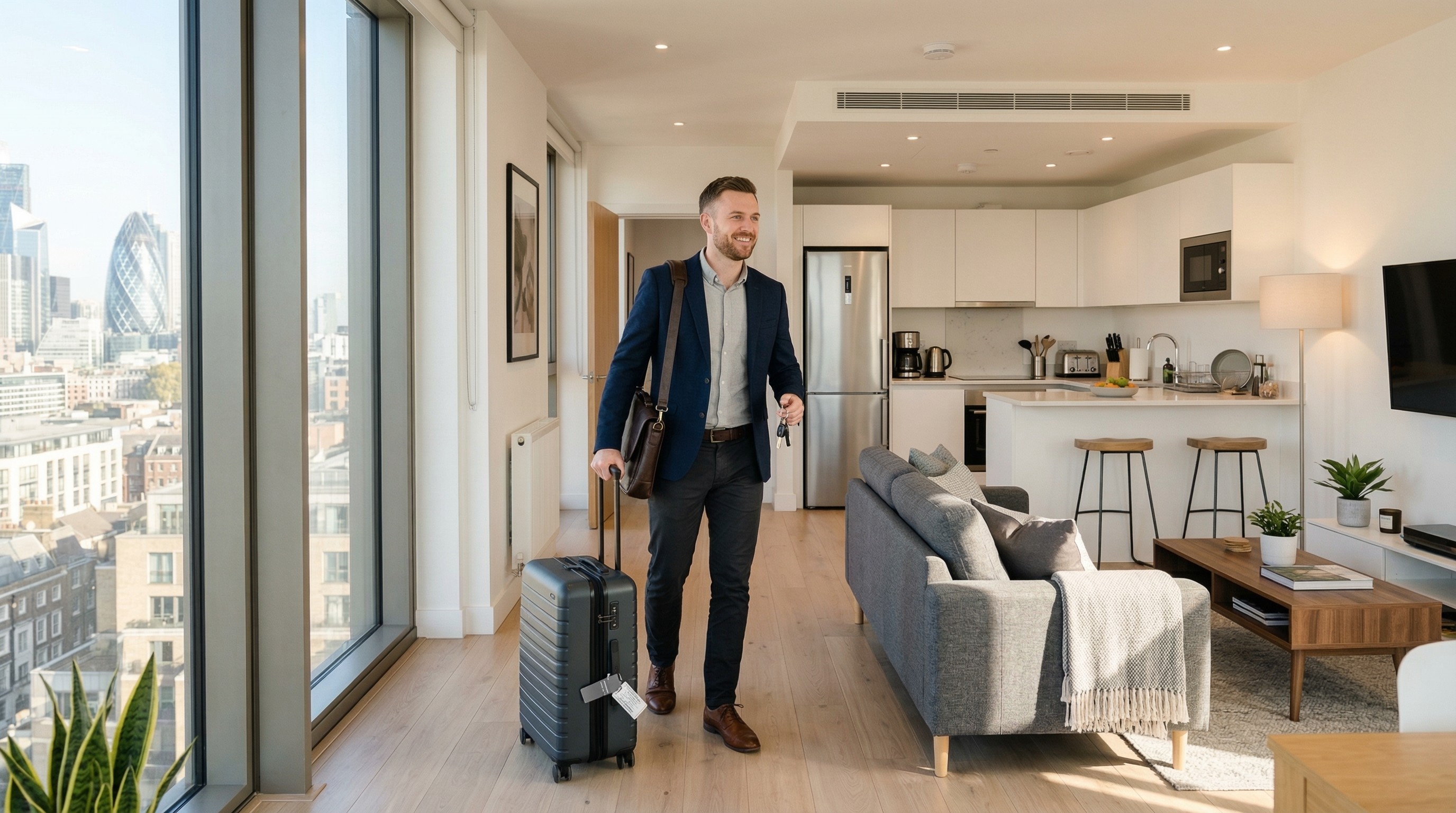
Smart access systems have eliminated the key collection problem. The days of needing to be available during a specific window to collect physical keys are largely behind us. Smart lock systems allow guests to receive a unique entry code before arrival and check themselves in at any hour without any human interaction required.
Property management apps allow guests to communicate with management teams, report issues, request additional items, and manage aspects of their stay from their phone, making the administrative side of an extended stay significantly simpler than it once was.
Smart home features in premium serviced apartments now include app-controlled heating, keyless entry, streaming-ready televisions, and connected kitchen appliances. These features are not gimmicks. They directly improve the daily experience of living in the property.
Digital communication has transformed the relationship between guests and management teams. Same-day responses to maintenance requests, pre-arrival messaging with everything you need to know about your stay, and clear digital check-out instructions all contribute to a stay that feels professionally supported without ever feeling intrusive.
Online booking transparency has improved dramatically. The best professional operators present their properties with comprehensive photography, honest and specific amenity descriptions, verified guest reviews, and clear pricing that shows exactly what is included. Smart travellers in 2026 use these resources systematically to make well-informed booking decisions rather than relying on brand familiarity or habit.
10. Family and Group Travel: Why Serviced Apartments Win Every Time
For families and groups, the case for serviced apartments over hotels has always been compelling and in 2026 it is essentially unanswerable.
The cost arithmetic alone is decisive. A family of four in a hotel needs either one family room, which is often little more than a standard room with an additional bed squeezed in, or two separate rooms. A two-bedroom serviced apartment gives the same family two proper bedrooms, at least one bathroom, a kitchen, a living room, and genuine space to function as a family unit rather than a group of individuals sharing a room. The per-person cost of the serviced apartment is almost always lower, often significantly so.
The practical advantages for families are substantial. Children can be put to bed while adults continue their evening in the living room without the entire family having to maintain hotel-room quiet. Breakfast for four can be made in the kitchen for a fraction of the hotel breakfast cost. Nap times, feeding routines, and the general logistical complexity of travelling with young children are all more manageable in a home environment than a hotel room. A washing machine means you do not need to pack a week's worth of children's clothing for a three-night trip.
For groups of friends, the serviced apartment creates a social experience that is simply not replicable with separate hotel rooms. The pre-event build-up in a shared living space. The post-dinner debrief over drinks at the kitchen table. The morning of a match day with everyone together in the apartment rather than scattered across different hotel floors. These shared moments are part of the trip, and a serviced apartment makes them possible in a way that hotels fundamentally cannot.
11. The Corporate Travel Shift: What Businesses Are Learning
Corporate travel managers and HR teams responsible for employee accommodation have been among the earliest and most systematic adopters of the serviced apartment model, and the reasons are well-documented and increasingly widely understood.
Duty of care obligations are better met by professionally managed serviced apartments than by many hotel alternatives. A property with documented safety compliance, a named management team, clear emergency contact protocols, and a professional commitment to guest wellbeing provides a more demonstrably robust duty of care framework than a budget hotel booking made through a corporate rate system.
Cost efficiency at volume is compelling. When a company is placing multiple team members in Manchester over an extended period, the per-night saving of a well-negotiated serviced apartment programme over a comparable hotel programme can be substantial across the full volume of nights. This is money that flows directly back to the travel budget.
Employee satisfaction and performance are genuinely better supported by serviced apartment accommodation. Employees who are well-rested, eating properly, maintaining some semblance of normal routine, and not feeling perpetually confined to a single hotel room perform better and report higher satisfaction with their work travel experience. This has measurable impacts on retention, productivity, and the quality of work delivered on project-based assignments.
Administrative simplicity improves with a single professional provider managing multiple bookings. Professional invoicing, clear billing, consistent communication, and a single point of accountability are all significantly easier to manage than multiple individual hotel bookings across different platforms and providers.
The Association of Serviced Apartment Providers has consistently reported that corporate demand for extended-stay serviced apartment accommodation is among the fastest-growing segments of the UK accommodation market. Companies that have made the transition from hotel-default to serviced apartment programmes rarely reverse the decision.
12. Location Flexibility: Getting Closer to Where You Actually Want to Be
One of the underappreciated advantages of serviced apartments over hotels is the distribution of available properties across a city's neighbourhoods.
Hotels, particularly well-known chains, cluster around transport hubs, conference centres, and the most commercially active parts of a city centre. This makes them convenient for certain purposes but means that the range of neighbourhood experiences available to hotel guests is relatively narrow. If you want to stay in a specific, characterful part of the city because it suits your trip better, the hotel options may be limited or non-existent.
Serviced apartments, by contrast, are distributed much more widely across a city's residential and mixed-use neighbourhoods. In Manchester, professionally managed serviced apartments are available in Ancoats, Castlefield, the Northern Quarter, Spinningfields, Didsbury, Salford Quays, and a range of other areas that have limited or no hotel provision. This distribution gives guests the ability to choose a neighbourhood that genuinely matches the character and purpose of their trip rather than defaulting to wherever the hotels happen to be.
For first-time visitors who want to experience the authentic energy of Ancoats rather than the generic city centre hotel strip, this matters. For professionals whose work is based at MediaCityUK and who want to walk to their office rather than commute from the city centre, this matters. For families who want a quiet, residential neighbourhood with good schools and green spaces nearby, this matters enormously.
Smart travellers in 2026 understand that location choice is not binary between city centre and suburb. It is a nuanced decision about neighbourhood character, daily convenience, and the specific experience they want their stay to deliver. Serviced apartments give them the full spectrum of choices that hotels simply cannot.
13. The Quality Consistency Question
A fair and important point in any comparison of serviced apartments and hotels is consistency. Hotels, particularly branded chains, deliver a predictable standard. You may not be blown away by a mid-range chain hotel, but you know broadly what you are getting before you arrive. The room will be clean. The check-in will work. The Wi-Fi will function.
This predictability has historically been cited as a reason to prefer hotels, particularly by less experienced travellers or those booking last-minute without time for detailed research. And it is a legitimate point, with an important qualification.
The quality consistency advantage of hotels applies specifically to branded chains. It does not apply to independent hotels, boutique properties, or the broader non-chain accommodation market, all of which vary as widely as any other accommodation category.
More importantly, the consistency advantage of hotel chains has been substantially eroded in the serviced apartment market by the emergence of professional management companies who apply equally rigorous standards across their property portfolios. A professionally managed serviced apartment from a reputable operator delivers consistency of standard that is every bit as reliable as a mid-range hotel chain, combined with a significantly better experience across every other dimension we have discussed in this guide.
The key word is professional. Booking a serviced apartment through a professional management company is a fundamentally different proposition from booking an unmanaged private listing. The former delivers consistency, accountability, and genuine quality assurance. The latter is variable by definition.
Smart travellers in 2026 have learned to distinguish between the two, and they book accordingly.
14. Manchester as a Case Study: The Serviced Apartment Advantage in Action
Manchester is one of the UK's most compelling examples of a city where the serviced apartment advantage plays out with particular clarity. The city's diverse neighbourhood landscape, its growing reputation as a destination for business, culture, food, and sport, and its rapidly expanding stock of professionally managed short-stay properties all combine to make it an ideal environment for experiencing everything that serviced apartment living has to offer.
In Ancoats, converted Victorian mill buildings house some of the most beautifully designed serviced apartments in the UK, placing guests within walking distance of nationally acclaimed restaurants and a thriving creative community that no hotel in the area can match for atmosphere or location quality.
In Castlefield, canal-side apartments offer a genuinely peaceful and scenic environment that is entirely distinct from the standard city centre hotel experience, yet remains within easy reach of the city's commercial and cultural core.
In Spinningfields, premium serviced apartments serve the needs of business travellers with a level of workspace quality, broadband reliability, and professional management that equals or surpasses what the area's corporate hotels offer at comparable price points.
Across all of these areas, and across the full range of visitor types that Manchester attracts, the serviced apartment option consistently delivers more space, more independence, better value, and a more authentic connection to the city than the hotel default.
For those exploring the full range of serviced apartment options available in Manchester, the team at Beyond Stays Group offers deep local knowledge across every neighbourhood we have discussed, combined with a curated portfolio of professionally managed properties that represent the very best of what Manchester's serviced apartment market has to offer.
And for a comprehensive understanding of which Manchester neighbourhood best suits your specific trip, our guide to where to stay in Manchester for short stays walks through every key area in detail, helping you make the most informed choice possible before you book.
15. Making the Switch: How to Start Choosing Smarter Accommodation
If you have reached this point in the guide, you have a clear and comprehensive picture of why smart travellers in 2026 are choosing serviced apartments over hotels. The question now is practical: how do you make this shift in your own travel planning?
Start with your trip purpose and duration. For any stay of two nights or more, begin your accommodation search with serviced apartments rather than treating them as a fallback if hotels do not work out. This simple change in search order opens up a range of options that many travellers never encounter simply because they default to hotel booking platforms first.
Choose a professional operator over unmanaged listings. The quality of the management behind a serviced apartment is as important as the quality of the property itself. Booking through a professional management company like Beyond Stays removes the uncertainty and variability that characterises unmanaged private listings and delivers the consistency and reliability that smart travellers require.
Account for the full cost. When comparing a hotel and a serviced apartment, do not just compare headline nightly rates. Calculate the full cost of each option including meals, laundry, parking, and ancillary charges. The true comparison almost always makes the serviced apartment case stronger than the headline rates suggest.
Think about your neighbourhood. Use the location flexibility that serviced apartments offer to choose a base that genuinely suits your trip rather than defaulting to wherever the hotels are concentrated. The right neighbourhood can transform your entire experience of a city.
Ask the right questions before booking. Wi-Fi speed, exact amenity provision, housekeeping frequency, cancellation terms, and management contact details are all worth establishing before you commit. A professional operator will answer all of these questions clearly and promptly.
The shift from hotel to serviced apartment is not a radical change in how you travel. It is a smarter version of the same journey, with meaningfully better outcomes across almost every dimension that matters. In 2026, the most experienced and informed travellers have already made this switch. The only question is whether you are ready to join them.
Ready to experience the serviced apartment difference on your next Manchester stay? Book a call with the Beyond Stays team today. Their local experts will match you with a property that delivers everything a smart traveller needs, at a price that makes sense, in a neighbourhood that genuinely suits your trip. Make 2026 the year you travel smarter.
FAQs: Why Smart Travellers Are Choosing Serviced Apartments in 2026
1. Why are serviced apartments becoming more popular than hotels in 2026?
Several converging factors are driving the shift. Travellers are more cost-conscious and are calculating the true total cost of accommodation rather than just the headline nightly rate, where serviced apartments consistently win for stays of two or more nights. The rise of remote and hybrid working has created a need for proper workspace and home infrastructure during trips. Growing awareness of wellbeing has highlighted the benefits of space, kitchen access, and a settled home environment. And the improvement in quality and professionalism across the serviced apartment sector has eliminated the consistency concerns that once favoured branded hotels.
2. Are serviced apartments in 2026 as reliable and consistent as hotel chains?
When booked through a professional management company, yes. The key distinction is between professionally managed serviced apartments, which operate to defined and consistent quality standards with documented safety compliance and reliable guest support, and unmanaged private listings, which vary considerably. Booking through a reputable professional operator like Beyond Stays delivers a level of consistency and quality assurance that is entirely comparable to a mid-range hotel chain, combined with a substantially better guest experience across space, independence, value, and comfort.
3. Do serviced apartments in 2026 offer the same technology and convenience as modern hotels?
The best-managed serviced apartments in 2026 offer smart access systems, app-based communication with management teams, streaming-ready entertainment, high-speed exclusive broadband, and a range of smart home features. In terms of the technology that actually matters to the daily experience of a stay, professionally managed serviced apartments are fully comparable to contemporary hotels and in many cases superior, particularly on broadband quality and access flexibility.
4. How do serviced apartments support sustainable travel compared to hotels?
Serviced apartments typically have a lower per-guest environmental footprint than comparable hotels. Less frequent housekeeping reduces water and chemical consumption. Self-catering reduces food waste compared to hotel buffet operations. Guests control their own heating and lighting rather than operating within a building-wide climate control system. And the spending patterns of self-catering guests, who shop locally and eat at independent restaurants, distribute economic benefit more widely within the local community than hotel-concentrated spending.
5. How do I find a high-quality serviced apartment in Manchester for my 2026 trip?
The most reliable approach is to book through a professional short-stay management company with a proven track record in the Manchester market. Look for operators with a clearly managed property portfolio, honest and comprehensive listings with verified guest reviews, transparent pricing that specifies exactly what is included, and a professional and responsive communication style. Beyond Stays combines all of these qualities with deep local knowledge of Manchester's neighbourhoods, making them an excellent starting point for anyone planning a Manchester stay in 2026 and beyond.